
- Home
- VR Demo Library
- VR Lockout/Tagout Training for Industrial Safety
VR Lockout/Tagout Training for Industrial Safety
- 2:09 runtime
- Manufacturing
- Updated March 2026
Overview
What You'll See in This Demo
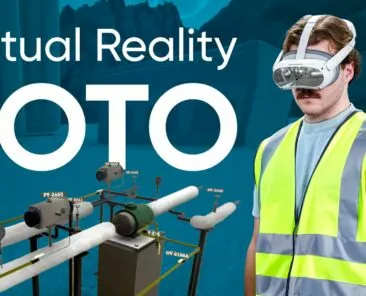
This demo shows what it looks like when safety-critical training moves out of the classroom and into a fully immersive, risk-free virtual environment. Where the stakes are real enough to build genuine competence, but the consequences of mistakes stay virtual. Learners work through a detailed energy control and isolation protocol, completing each step of a lockout/tagout sequence in a simulated field environment that mirrors the equipment and conditions they’ll encounter on the job. For organizations where procedural errors carry serious human and operational costs, from chemical plants to manufacturing facilities to energy operations, this is what readiness looks like before anyone steps into the live environment.
Whether you’re a safety and compliance leader, an HR or L&D team, or a plant operations manager, this immersive approach — spanning from energy isolation protocols to industrial vehicle training with the PIT Trainer XR — demonstrates how VR can close the gap between knowing the procedure and being prepared to execute it.
Key Learning Objectives
FAQ
Common Questions
Transcript
Video Transcript
00:00 | Welcome
This module will walk you through the lockout process from beginning to end using an energy control and isolation protocol scenario.
00:08 | Module Overview: Energy Control and Isolation Protocol
What we’re looking at today is a virtual reality training project we built for a large chemical products company. The program is really centered around safety, lockout-tagout procedures, and obviously standardization for safety protocols is crucial.
00:21 | Why VR for Lockout-Tagout Training
So what we were able to do is create their lockout-tagout procedures in what looks like their field environment so that new employees could build muscle memory, build critical confidence, and really just practice these safety protocols in a risk-free environment.
Oftentimes when doing live environment training, you’re shutting down a machine, you’re taking high-performing operators offline to do shadow shifts and to walk folks through these type of experiences. Where in a virtual world, it’s very self-guided; it’s something that somebody can go through over and over and build some of those critical skills before they get on the live equipment.
00:57 | Reducing Disruption to Live Operations
It’s not necessarily going to replace the need to be on live equipment, but it can better prepare individuals for that live environment to shorten overall training time.
Obviously, when you’re practicing these in a virtual environment, one, you’re not going to cause any harm to yourself, others, or equipment. But also, we can simulate all sorts of situations and show the results of mistakes in a virtual world so that somebody can use that to learn and build confidence for when they are out in the field, or if they’re on live equipment or practicing a lockout-tagout procedure in real time.
01:29 | Simulating Mistakes Safely
Although we’re looking today at a chemical industry example of lockout-tagout, these type of protocols and safety procedures can be practiced across industries. The ability to customize a virtual reality experience — to match your equipment, to match your processes and procedures.
Whether you’re in the manufacturing space or in the chemical space, virtual reality is going to give you the ability to do that and match real-world environments.
01:54 | How to Get Started with Roundtable Learning
If you have questions or you’re interested in demoing some of these examples, you can always reach out to us through our website. You can reach out to me directly at [email protected]. You can always come down and see us in Chagrin Falls, Ohio and test the equipment out live as well.
See It Live
More VR Demos

Program Stats
Format: Custom-Built VR
Headset: PICO 4E
Modules: 2
Analytics: Mercury XRS
Licensing: Unlimited Users