
Key Points
- Physical skill acquisition moves from conscious, heavy mental effort to completely unconscious, automatic movement.
- Early training requires clear instruction and frequent feedback because learners make frequent, dramatic errors as they figure out the mechanics.
- Advanced practice focuses on refining small details and building consistency in varied environments.
- Modern spatial technology accelerates this process by providing safe, repeatable environments for necessary physical practice.
You watch a new forklift operator aggressively jerk the steering wheel, overcorrect, and hit the brakes far too hard. While it looks like pure incompetence, you are actually watching the human brain struggle through the intense neurological process of building a new physical skill. We cannot expect smooth performance until we understand how the body actually learns to move.
Table of Contents
Understanding the Neuroscience of Movement
Learning a physical task requires fundamentally different instructional design than teaching a cognitive concept, such as compliance rules. When we discuss the stages of motor learning, we are tracking how the brain builds and reinforces neural pathways to control muscle movement. The goal is to move a behavior from the slow, analytical prefrontal cortex to the fast, automatic cerebellum.
You can read more about the intersection of cognitive neuroscience and VR, but the core concept remains simple. The brain requires repeated, physical trial and error to build lasting muscle memory. Instructors have broken this neurological journey down into three distinct, predictable phases.
Stage 1: The Cognitive Phase
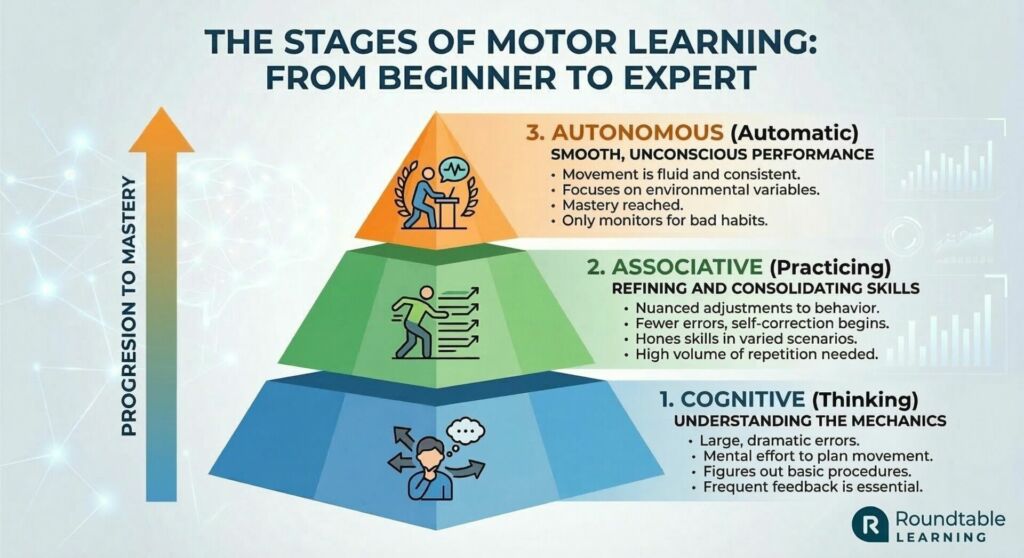
During this initial phase, the learner relies entirely on conscious, active thought to perform the task. They have to literally talk themselves through every single step of the procedure as they do it. Because their brains are working so hard to understand the basic mechanics, their physical performance is incredibly stiff, slow, and riddled with massive errors.
L&D professionals must provide explicit, step-by-step instructions and frequent, immediate feedback during this stage. Establishing clear learning objectives ensures the employee knows exactly what successful movement looks like. The learner is simply trying to figure out “what to do” rather than “how to do it well.”
Stage 2: The Associative Phase
Once the learner grasps the basic mechanics, they move into the associative phase of practice and refinement. The massive, clunky errors decrease significantly as the employee starts to recognize their own mistakes and self-correct in real time. They no longer need to think about the broad strokes of the task; instead, they focus on improving their speed, efficiency, and consistency.
This stage requires a high volume of repetition across varied, realistic scenarios. Providing consistent reinforcement of learning ensures that these new neural pathways do not degrade over time. The instructor’s role shifts from a direct teacher to a coach, providing nuanced feedback on small, specific details rather than the overall process.
Stage 3: The Autonomous Phase
In the final stage of skill acquisition, the physical movement becomes entirely automatic and unconscious. The employee can perform the complex task smoothly and accurately while their conscious mind focuses on other environmental variables. They can operate the forklift perfectly while simultaneously carrying on a conversation with a coworker or scanning the warehouse for safety hazards.
Reaching this level of mastery takes significant time and cannot be rushed by simply watching more training videos. To combat the Ebbinghaus forgetting curve, employees must physically perform the task repeatedly until it becomes a deeply ingrained habit. At this stage, instructors only need to step in to correct bad habits that may slowly drift into the employee’s routine.
Accelerating the Process with Spatial Tech
Historically, moving employees through these three phases required expensive, risky on-the-job training. Today, instructional designers use spatial computing to simulate the physical workspace, allowing employees to build muscle memory without risking actual equipment. They can fail safely during the cognitive phase without shutting down a live production line.
Digital simulations provide the exact type of repeatable, hands-on practice required to reach the autonomous phase faster. Understanding how to leverage VR training for employees helps you shorten the time required to acquire physical skills. You give the brain the physical repetition it craves in a perfectly controlled, scalable environment.
Designing an effective curriculum requires aligning your technology and teaching methods with the biological reality of how humans actually learn. If you want to build programs that support genuine physical skill development, explore our immersive training solutions. At Roundtable Learning, we can help you transition your workforce from hesitant beginners to confident experts when you contact our instructional design team.