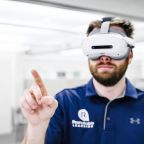
The best safety VR training for frontline teams puts workers in a replica of their own site, where they can make the mistakes that hurt people there and see the consequences before anything happens for real. It also records each session, so supervisors know who is ready and who needs another round. That matters most for warehouse associates, machine operators, drivers, and ramp crews, whose jobs carry the most physical risk.
Roundtable Learning builds custom virtual reality training for safety for enterprise frontline teams and sells PIT Trainer XR, a ready-to-use forklift program. Our safety work includes programs for BNSF Railway, an aerospace manufacturer, and a global air cargo operator, each built around the client’s real equipment and procedures.
Key Points
- Transportation and material moving workers recorded more workplace deaths in 2024 than any other occupational group, according to the BLS.
- The best safety virtual reality training is built on your site and equipment and records each learner’s performance.
- Off-the-shelf programs such as PIT Trainer XR fit standardized tasks, while site-specific hazards call for a custom build.
- VR prepares workers for hands-on evaluation, but OSHA still requires workplace evaluation for forklift operators.
Why Do Frontline Teams Need Safety VR Training?
Private industry employers reported 2.5 million nonfatal workplace injuries and illnesses in 2024, and 5,070 workers died from work injuries that year. Workers in transportation and material moving occupations accounted for 1,391 of those deaths, more than any other occupational group. The National Safety Council estimates the cost of a single medically consulted work injury at $48,000 and notes that its figures measure the cost to society, not to employers alone.
Most of that risk falls on people on floors, docks, ramps, and roads. Their training often ends with shadowing on live equipment, so a new associate’s first wrong step near a moving load can happen on the job. Frontline workers learn the riskiest parts of the job on live equipment unless training gives them a safer place to practice.
What Does The Best Safety VR Training Have In Common?
The programs that change behavior on the floor share a handful of traits:
- The environment comes from your site. A 1:1 replica of your cargo hold, press, or loading dock means workers practice the layout they will face.
- Mistakes have visible consequences. A learner who skips a lockout step or stands too close to a load sees what would have happened and gets another attempt, with no one hurt.
- They track body movement as well as controller input. In our air cargo program, ankle-worn motion trackers catch unsafe foot placement with step-recognition accuracy of 98% or higher.
- Supervisors get actionable data because every session can feed Mercury XRS and show who is struggling with which step before that person works near a live load.
- They do not need a dedicated training room. The air cargo kit costs about $1,000, runs offline on a self-contained headset, and needs only 10 feet of floor space, so it can ship to any site in the network.
Lockout/tagout and powered industrial trucks both appear on OSHA’s preliminary list of the 10 most frequently cited standards for fiscal year 2026. For forklifts, OSHA’s standard requires formal instruction, practical training, and an evaluation of the operator’s performance in the workplace, with a new evaluation at least once every three years. Good safety VR training prepares operators for that hands-on evaluation, but it does not replace it.
Safety VR Training By Industry
Frontline hazards vary by sector. The strongest scenarios come from your incident reports and near-misses because they reflect the hazards your team will face. These are some of the industries Roundtable serves and what workers practice in each:
- Manufacturing operators practice lockout/tagout, welding, and CNC machine work, and one aerospace client cut spindle crashes from 10 a year to two.
- New warehouse associates learn forklift handling and safe movement around equipment before peak season starts.
- Logistics drivers practice backing up and turning in hazardous conditions without the stress of real traffic.
- Aviation ground crews rehearse de-icing, cargo loading, and ramp procedures, including rare emergencies that are too costly to stage for real.
- In healthcare, nurses and clinical staff practice high-stakes procedures without risking patients.
- Retail store teams prepare for safety and security situations they hope never to face.
- Engineering teams train on systems that would otherwise take weeks to free up for training.
Should You Choose Off-The-Shelf Or Custom Safety VR Training?
Off-the-shelf training works when the task is the same everywhere. PIT Trainer XR covers forward and reverse maneuvers, pivot control, material handling, and more on any standing tiller truck, including forklifts, order pickers, and reach trucks. Each PIT Trainer XR unit costs $12,995 and includes the rig, a PICO 4 Ultra headset, and a year of Mercury XRS.
Renewal is $4,995 per unit per year; there is no user limit, and you can trial it free for 60 days. It is not an OSHA-certified course, but it prepares learners for OSHA forklift certification.
Custom VR safety training makes sense when your hazards are specific to your site or equipment. A typical Roundtable pilot runs 8 to 12 weeks with a team of four to eight people, and delivers an alpha build, an instructor guide, and a pilot report with metrics. Single-module, entry-level projects start at $50,000.
How Do You Choose The Best VR Safety Training Provider?
Before you sign with a provider, ask these five questions:
- Will you observe our site and talk to our safety team before building anything?
- Who owns the finished content, and can we update it ourselves?
- What data will we get, and can it flow into our LMS?
- Who handles headset shipping and device management?
- Can you show measured results from a similar safety program?
At Roundtable, you own your content, our programs connect to LMS platforms through xAPI and SCORM, and we handle headset logistics and remote rollouts. Get a clear answer on content ownership, because a program you cannot update goes out of date as soon as your procedures change. You can compare our results with other options in our case studies.
Summary
The best safety VR training for frontline teams recreates your own site and shows supervisors, session by session, who is ready to work near live equipment. Choose off-the-shelf for standardized tasks such as basic forklift operation, and custom work for hazards specific to your operation.
To scope a safety program around your highest-risk task, contact Roundtable Learning. We will start with a needs assessment and a visit to the site where the work happens.
Sources:
- U.S. Bureau of Labor Statistics, Employer-Reported Workplace Injuries and Illnesses, 2023-2024
- U.S. Bureau of Labor Statistics, Census of Fatal Occupational Injuries Summary, 2024
- National Safety Council, Injury Facts, Work Injury Costs, 2024
- Occupational Safety and Health Administration, Top 10 Most Frequently Cited Standards, Fiscal Year 2026
- Occupational Safety and Health Administration, 29 CFR 1910.178, Powered Industrial Trucks