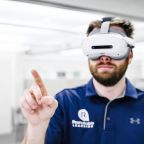
Custom VR training improves skill retention because employees learn a task by doing it in a replica of where they will actually perform the tasks. They repeat the procedure and make mistakes without consequences, while the simulation corrects them on the spot, so they rehearse the skill instead of hearing about it or watching from the sidelines. Bring that practice back in short, spaced refreshers and the skill is more likely to hold up when they need it on the job.
Roundtable Learning designs and builds custom VR training for enterprise teams. Our process starts with a needs assessment and includes an on-site visit, so the environment matches your equipment and procedures, and Mercury XRS tracks each learner’s performance after launch. Our extended reality training team can also combine VR with AR, mixed reality, and eLearning.
Key Points
- Skills that employees practice once and then rarely use fade quickly, and VR can slow that loss by replacing explanation with hands-on practice.
- In a Roundtable Learning program for Kellanova, buyers who experienced VR training recalled 30% more key facts a week later than buyers who saw slides.
- Custom content supports retention because learners practice on the same equipment and follow the same steps they will use at work.
- Short modules and spaced refreshers keep skills from slipping after launch.
Why Do Employees Forget What They Learn In Training?
Memory fades fastest right after learning and then levels off. Hermann Ebbinghaus mapped this pattern in the 1880s, and a 2015 PLOS ONE study that repeated his method produced results close to his original curve. For training teams, that means a one-day session on a procedure people will not perform for weeks starts working against the forgetting curve within the first hour.
The loss is worst for skills employees use rarely. An emergency shutdown, a lockout on a machine they seldom service, or a difficult customer conversation that comes up twice a year all decay between uses. Watching a video or reading a procedure gives people information, but it does not provide the repetition that makes recall automatic under pressure.
How Does VR Training Improve Skill Retention?
VR training improves skill retention by changing what learners do. Instead of watching a demonstration, they perform each step in a space that looks and responds like the real one, and several things happen at once:
- Learners pick up the tool, open the panel, or walk the route themselves, building the kind of motor memory a slide deck cannot.
- Location starts working as a memory cue. In a 2018 University of Maryland study of 40 volunteers, recall accuracy was 8.8% higher when information was presented in a VR headset than on a desktop screen.
- Attention stays on the task, and PwC’s 2020 study found that VR learners were up to four times more focused than their eLearning peers and felt 3.75 times more emotionally connected to the content than classroom learners.
- When a learner drops a load or skips a lockout step, they see what happens and try again, and nobody gets hurt.
These effects depend on scenarios that ask learners to act and decide, so passive video in a headset delivers few of them. Our article on cognitive neuroscience and VR explains the brain science behind how VR training improves skill retention.
Why Does Custom VR Content Matter For Retention?
Generic VR content trains people on equipment that may look nothing like theirs. When the virtual control panel and floor layout match the real ones, learners have nothing to translate when they walk onto the floor.
That is why Roundtable builds environments from each client’s own equipment and sites. BNSF Railway mechanics train inside a 1:1 replica of a Tier 4 locomotive and can repeat each procedure until it feels familiar before they touch the real engine. For Kellanova, we modeled every SKU, shelf, and display in the VR shopper journey against real planograms. In both cases, learners practiced on a faithful copy of the locomotive or store aisle they would face at work.
Off-the-shelf content is enough for some tasks. Basic forklift maneuvers are similar across most distribution centers, so a ready-made program such as PIT Trainer XR covers them well, while site-specific equipment and processes usually call for a custom build. Our guide to custom vs. off-the-shelf training content walks through that decision.
What Do The Results Show?
The clearest link between VR training and skill retention in Roundtable’s portfolio comes from Kellanova, now part of Mars Snacking. One week after the session, buyers who experienced the content in VR recalled 30% more key category facts than a control group that saw the same content on slides. Each VR experience ran only four to five minutes.
Other programs show the impact of VR training on skill retention through on-the-job behavior. An aerospace manufacturer trained CNC operators in VR and went from 10 spindle crashes a year to two, a change the case study puts at $800,000 in net savings. At Superior Beverage, where VR practice was one of three formats alongside video and eLearning, new hires reached full productivity 33% faster. You can read the details in our case studies.
How Do You Design VR Training So Skills Stick?
Improving skill retention with VR training starts at the design stage. Five design choices help most:
- Keep modules short. Roundtable generally recommends VR activities of about 20 minutes, and the Kellanova experiences ran four to five minutes.
- Space the practice out. A 2006 review in Psychological Bulletin, covering 317 experiments on verbal recall, found that the longer people need to remember something, the wider the gaps between study sessions should be.
- Build consequences into the scenario. Branching logic lets a wrong decision play out to its consequence, which gives the learner something concrete to remember.
- Correct errors as they happen. Roundtable’s air cargo safety program uses ankle-worn motion trackers that flag an unsafe step the moment a learner makes it.
- Test again later. For procedures people rarely perform, check at one week and again after 30 to 90 days, and use in-headset data on errors and missed steps to see where the skill slipped.
A retention check only means something if it happens weeks after training, on the same task the learner will perform at work. Pair it with on-the-job measures such as error rates, near-misses, rework, and time to proficiency.
Summary
VR training improves skill retention by turning instruction into realistic, repeated practice with immediate feedback. Custom content matters because practice on your own equipment transfers directly to the job, and spaced refreshers keep the skill from fading.
If you want to see what this could look like for your team, talk to Roundtable Learning about a pilot built around one high-stakes task. The first step is a needs assessment, so you know where skills slip before anything gets built.
Sources:
- Murre and Dros, Replication and Analysis of Ebbinghaus’ Forgetting Curve, PLOS ONE, 2015
- Krokos, Plaisant and Varshney, Virtual Memory Palaces: Immersion Aids Recall, University of Maryland, 2018
- PwC, Virtual Reality Soft Skills Training Efficacy Study, 2020
- Cepeda, Pashler, Vul, Wixted and Rohrer, Distributed Practice in Verbal Recall Tasks: A Review and Quantitative Synthesis, Psychological Bulletin, 2006